How to Upload a File to Filezilla
This tutorial in other languages: English (English), Deutsch (German), Español (Castilian), Français (French)
Note to editors: Please read this note on the tutorial scope before making additions.
Introduction
Welcome to the FileZilla Client tutorial. In this tutorial, you lot will learn how to
- Connect to an FTP server,
- Download and upload files,
- Use the site manager.
If you already know how to apply an FTP client, yous may want to read the more advanced usage instructions instead.
Nosotros assume that you already installed and started FileZilla Client (installation instructions).
Connecting to a server
The first thing to practise is connecting to a server.
This is our (fictional) login data - please use your own data instead if you want to actively follow the tutorial.
Hostname: example.org Username: john Password: 7PjU#.J3
We volition use the quickconnect bar for establishing the connexion:

Enter the hostname into the quickconnect bar's Host: field, the username into the Username: field also equally the countersign into the Password: field. You may leave the Port: field empty unless your login information specifies a certain port to use. Now click on Quickconnect.
Note: If your login information specifies a protocol like SFTP or FTPS, enter the hostname as follows: sftp://hostname or ftps://hostname respectively.
FileZilla will now try to connect to the server. If all works well, yous will discover that the right "column" switched from Not connected to whatsoever server to displaying a listing of files and directories.
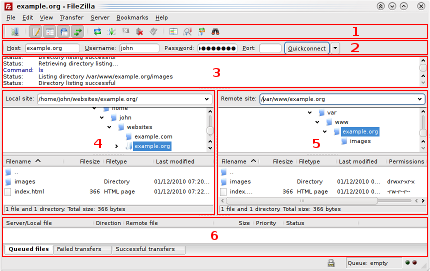
Legend: ane. Toolbar, ii. Quick connect bar, iii. Message log, four. Local pane, 5. Remote pane, vi. Transfer queue (Full-size version)
The next step is to become familiar with FileZilla's window layout.
Here is a quick introduction: Beneath the toolbar (i) and quick connect bar (2), the message log (3) displays transfer and connection related messages. Beneath, you can find the file listings. The left cavalcade (local pane, 4) displays the local files and directories, i.due east. the stuff on the PC you're using FileZilla on. The right cavalcade (server pane, 5) displays the files and directories on the server you are continued to. Both columns have a directory tree at the summit and a detailed list of the currently selected directory's contents at the bottom. You lot can easily navigate either of the copse and lists past clicking effectually like in any other file director. At the bottom of the window, the transfer queue (6) lists the to-be-transferred and already transferred files.
Transferring files
At present nosotros will upload these files (or the ones you lot choose, respectively):
website/ +- index.html +- images/ +- image01.jpg +- image02.jpg
Uploading
First - in the local pane - bring the directory into view which contains information to exist uploaded (e.g. index.html and images/). Now, navigate to the desired target directory on the server (using the server pane's file listings). To upload the data, select the respective files/directories and drag them from the local to the remote pane. You volition notice that the files will be added to the transfer queue at the bottom of the window and presently thereafter go removed over again - since they were (hopefully, if nothing went wrong) just uploaded to the server. The uploaded files and directories should now be displayed in the server content list at the correct side of the window.
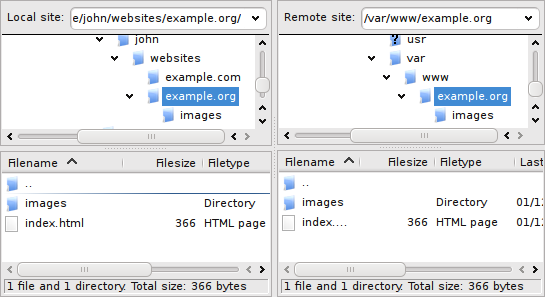
Local and remote file listings after uploading the example files
Note: If you don't similar using drag-and-driblet, you can also right click on files/directories (in the lower local pane) and select Upload to upload them - or only double-click a file entry (this does not work for directories).
Note (advanced): If y'all enable filtering and upload a consummate directory, merely the not-filtered-out files and directories within this directory will exist transferred.
Downloading
Downloading files, or complete directories, works substantially the same way as uploading - yous just elevate the files/directories from the remote pane to the local pane this fourth dimension, instead of the other mode circular.
Notation: In case you (accidentally) attempt to overwrite a file during upload or download, FileZilla volition by default brandish a dialog asking what to practise (overwrite, rename, skip...).
Using the site manager
Now that you are confident in transferring files (if not, exercise a lilliputian scrap), you lot might desire to add the server data to the site manager to get in piece of cake to reconnect to this server. To do this, select Copy current connection to Site Manager... in the File menu. The site manager will be opened and a new entry volition be created with all the important information already filled in. You will notice that the entry'southward proper name is selected and highlighted - you lot can enter some descriptive name so you will subsequently on find your server once again (enter something similar domain.com FTP server for case - you tin can rename it later if y'all wish). Now close the dialog by clicking on OK.
The next time you desire to connect to this server, you can simply select it in the site manager and click Connect.
Determination
You should now be able to use the basic FileZilla features.
Ane final remark: Most tasks can be completed in several ways. The ways called for this tutorial are the most clear ones - if you invest a bit of time and but await around or read some of the avant-garde documentation, yous volition find much quicker means to achieve what yous want (there are toolbar buttons for frequently-used commands for example; some as well react on right-clicking them).
If you feel reasonably confident by now, it might be worthwhile to too read the advanced usage instructions to learn about boosted features not shown in this tutorial.
Farther information
- Documentation: Documentation for the well-nigh important topics
- Site manager: Details about how to ready your sites in FileZilla
Source: https://wiki.filezilla-project.org/FileZilla_Client_Tutorial_(en)
0 Response to "How to Upload a File to Filezilla"
Post a Comment